

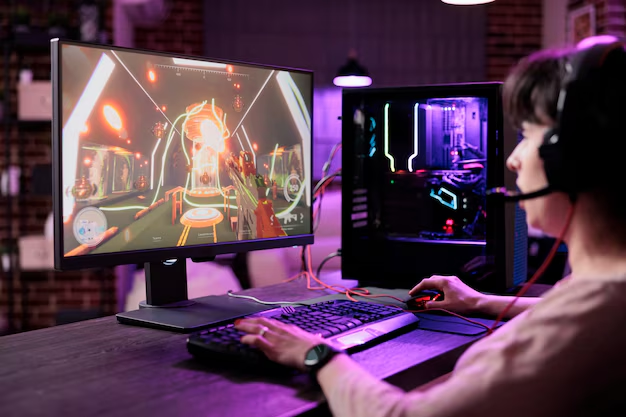
The world of online gaming has undergone a remarkable transformation since its inception, driven largely by the evolution of user interfaces (UI). From the rudimentary text-based interfaces of the early days to the highly sophisticated and immersive experiences of today, user interfaces have played a pivotal role in shaping how players interact with games and each other. This article delves into the evolution of user interfaces in online gaming, tracing the journey from simple command lines to complex graphical user interfaces (GUIs) and beyond.
The Early Days: Text-Based Interfaces and MUDs
In the early days of online gaming, user interfaces were a far cry from the visually rich experiences we know today. The first online games were largely text-based, relying on command-line interfaces that required players to input text commands to interact with the game world. These games, often referred to as Multi-User Dungeons (MUDs), were the precursors to modern MMORPGs (Massively Multiplayer Online Role-Playing Games).
The Simplicity of Text
MUDs, which emerged in the late 1970s and early 1980s, were entirely text-based, with no graphical elements to speak of. Players would type commands such as “go north” or “attack goblin” to navigate and interact with the game world. The user interface was minimalistic, consisting of a simple command line and text descriptions of the environment, characters, and objects. Despite the lack of visuals, these games were immensely popular because they offered a level of interaction and socialization that was previously unavailable in single-player games like Slot gacor.
Limitations and Creativity
The text-based nature of MUDs presented several limitations, primarily in terms of accessibility and user experience. Players needed to have a good command of language and the patience to navigate through lengthy text descriptions. However, these limitations also spurred creativity, both among players and developers. Players had to use their imagination to visualize the game world, while developers focused on crafting rich narratives and complex systems that kept players engaged despite the lack of graphical fidelity.
The Rise of Graphical User Interfaces
The late 1980s and early 1990s marked a significant turning point in the evolution of online gaming user interfaces with the introduction of graphical user interfaces (GUIs). The transition from text-based to graphical interfaces revolutionized how players interacted with games, making them more accessible and visually appealing.
The Advent of 2D Graphics
The first graphical online games featured 2D graphics, which, while primitive by today’s standards, represented a major leap forward from text-based interfaces. Games like “Habitat,” released in 1986, were among the first to use a graphical interface, allowing players to interact with a visually represented world rather than relying solely on text commands. Habitat’s interface included simple icons and a point-and-click system, enabling players to move their avatars and interact with objects by clicking on them.
The Evolution of HUDs
As graphical capabilities improved, so did the complexity of user interfaces. The introduction of heads-up displays (HUDs) allowed developers to provide players with real-time information, such as health bars, minimaps, and inventory screens, without breaking the immersion of the game. HUDs became a standard feature in many online games, enhancing the overall user experience by making it easier for players to keep track of essential information.
The Birth of MMORPGs
The evolution of GUIs played a crucial role in the birth of MMORPGs in the mid-1990s. Games like “Ultima Online” (1997) and “EverQuest” (1999) featured fully realized 2D and 3D graphical interfaces that allowed players to explore vast, persistent worlds alongside thousands of other players. These games introduced complex GUIs that included multiple windows, chat boxes, and customizable interfaces, giving players more control over how they interacted with the game world and other players. To get more information, you can go for circularityscotland.com.
Conclusion
The evolution of user interfaces in online gaming has been a journey of constant innovation and adaptation. From the humble beginnings of text-based MUDs to the sophisticated, immersive experiences of today, UIs have been at the forefront of shaping how players interact with games and each other. As technology continues to advance, the future of user interfaces in online gaming promises to be even more exciting, with new possibilities for immersion, accessibility, and personalization on the horizon.
